


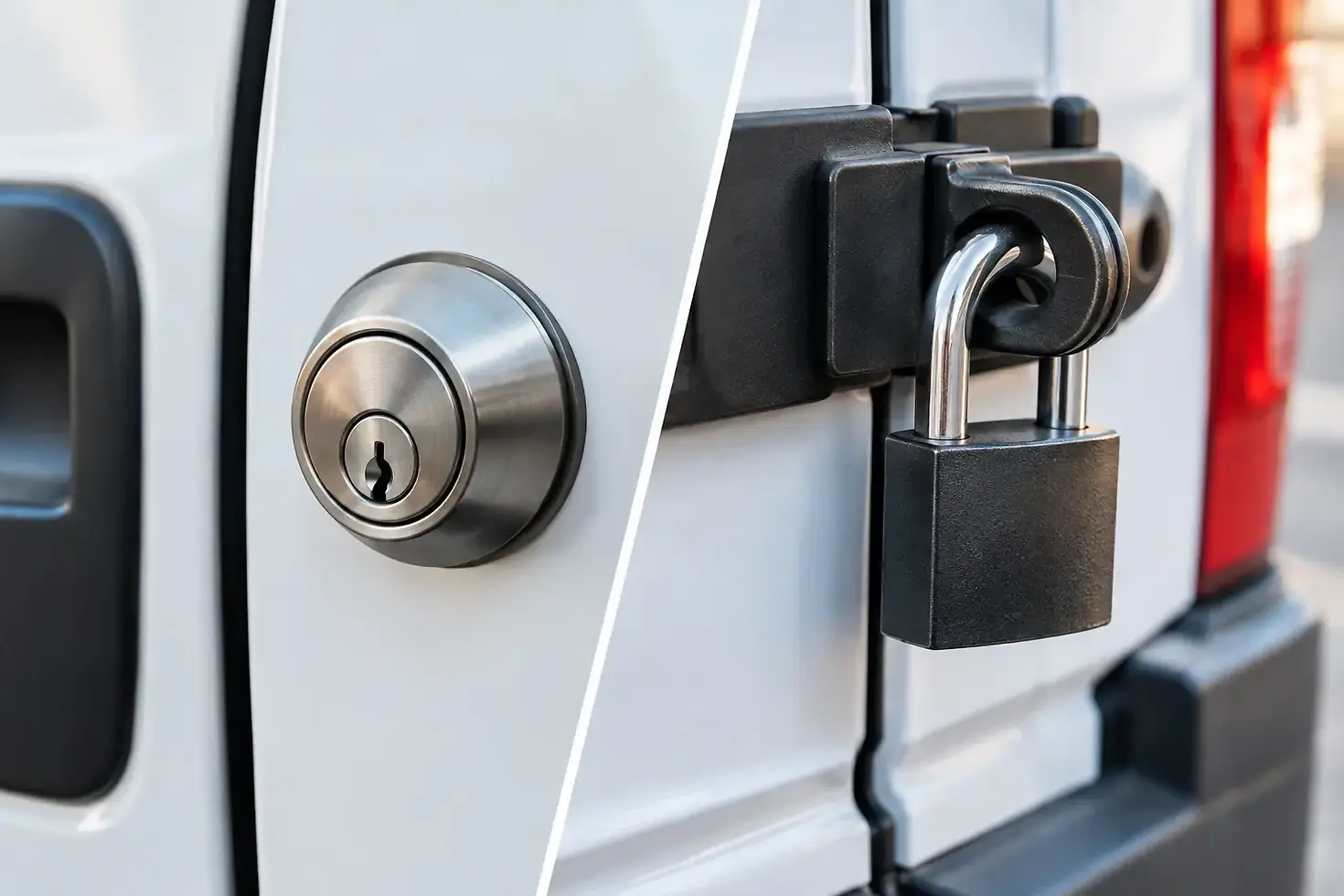
Deadbolts Versus Padlocks for Van Security

A thief targeting a work van is not looking for a lock that merely looks difficult. They are looking for a weak point: a hasp that can be pried open, a padlock body that can be cut, or a door skin that can be peeled back. That is where deadbolts versus padlocks becomes a practical decision, not a cosmetic one. The right choice affects whether your tools stay in the van, whether you lose a day's work, and whether your factory locking system is your only line of defense.
For commercial vehicles carrying tools, stock, or equipment, an independently operated deadbolt is usually the stronger primary security option. Padlocks still have a place, but only when the application, fitting position, and attack risk make sense.
Deadbolts Versus Padlocks: The Core Difference
A deadbolt locks by driving a solid bolt into a fixed receiver or keeper. On a van, that means the door is physically tied to the vehicle body or opposing door structure. The locking force is carried through purpose-built hardware rather than relying on the vehicle's standard latch.
A padlock is a removable lock that secures a hasp, staple, chain, or external locking bracket. Its strength depends on more than the padlock itself. The hasp, mounting bolts, exposed shackle, door panel, and surrounding metal all become part of the security system.
This is the key difference: a deadbolt is designed to become part of the van's structure, while a padlock is generally an external component securing two parts together. A high-quality padlock can be tough, but it cannot make a weak hasp or thin door skin strong.
Why Van Thieves Target External Weak Points
Trade vans are often attacked quickly, in parking lots, on driveways, and outside job sites. Thieves commonly use leverage rather than sophisticated lock picking. A crowbar can spread a door edge, deform a hasp, or expose enough of a padlock shackle to attack it. Rear and side loading doors are common targets because they provide direct access to tools.
Factory central locking adds convenience, but it is not always designed to resist sustained physical attack. If a thief compromises the factory lock, latch, or wiring, the vehicle can be opened without defeating an additional independent lock.
A properly fitted deadbolt changes that situation. Even if the original door lock is bypassed, the door remains held by a separate mechanical locking point. Remote-controlled deadbolts also remove the need to leave an exposed external padlock or stop to lock each door manually.
The problem with exposed shackles
Most traditional padlocks present an obvious attack point. Even hardened shackles can be vulnerable if there is enough clearance for cutters, a pry bar, or leverage tools. Closed-shackle and discus-style padlocks reduce exposure, but they still need a compatible hasp that shields the lock body and cannot be peeled away from the door.
This does not mean every padlock will fail. It means the complete installation must be judged as a system. A strong padlock fitted to a light-duty staple can give false confidence.
Where Deadbolts Have the Advantage
Deadbolts are purpose-built for the job when the goal is to secure a van's cargo doors against forced entry. They are particularly effective where owners want another physical layer beyond original equipment manufacturer locks.
The strongest advantage is independence. A deadbolt can remain locked even if the factory locking system is compromised. That matters on vans such as Ford Transit, Mercedes Sprinter, Ram ProMaster, VW Crafter, and other commercial models that may carry thousands of dollars of tools and equipment.
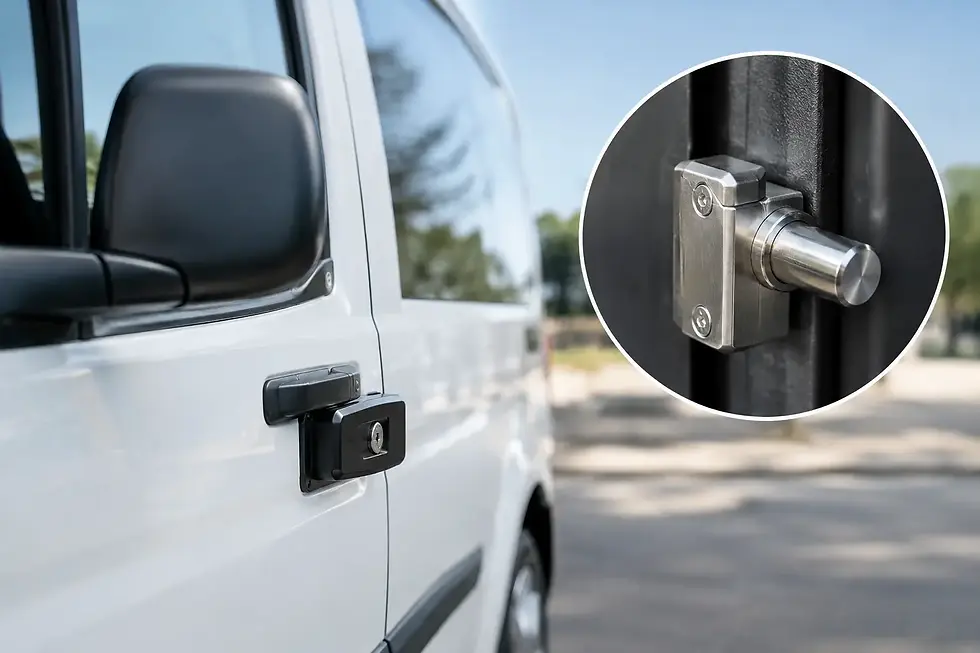
A concealed deadbolt installation also gives thieves less to work with. There is no loose padlock hanging from a door and no exposed shackle advertising exactly where to attack. The security hardware can sit inside the vehicle or behind a protected fitting point, while the exterior remains cleaner and less obvious.
Deadbolts are also better suited to repeated daily use. A remote system can lock and unlock quickly as the driver works through deliveries, service calls, or multiple job sites. That is easier to manage than handling padlocks in rain, snow, mud, or poor lighting.
Resistance to door peeling and crowbar attacks
A deadbolt is strongest when paired with reinforcement that addresses how vans are actually attacked. A bolt can stop the door from opening at one point, but a thief may still try to bend back the upper corner of a sliding or rear door.
Anti-peel brackets reinforce vulnerable areas and limit the gap a pry bar can create. Combined with a deadbolt, they make it harder to spread the door, reach the latch, or create an opening large enough to remove equipment. Van Security Systems designs this type of hardware around forced-entry methods rather than treating security as a simple add-on lock.
When a Padlock Still Makes Sense
Padlocks are not automatically the wrong answer. They can work well for temporary security, storage boxes, trailer doors, internal tool cages, site gates, or low-risk applications where a dedicated deadbolt installation is not possible.
They are also useful as a secondary visible deterrent. A heavy-duty padlock on a properly shielded hasp may persuade an opportunist to move on, especially when the vehicle is empty overnight. For older vehicles, short-term contracts, or removable equipment cabinets, the lower upfront cost can be attractive.
The trade-off is that external padlock systems require more attention to fitting and maintenance. The lock must be protected from weather, dirt, corrosion, and freezing conditions. The hasp must be thick enough to resist bending, its fixings must not be accessible from outside, and the padlock must not have a shackle that can be easily gripped or cut.
If you use a padlock on a van, avoid treating it as a standalone upgrade. Check the door edges, hinges, mounting surface, and access around the shackle. If a pry bar can get behind the hasp, the quality of the padlock may not matter.
Choosing the Right Security Setup for Your Van
The decision should start with the value of what is inside the vehicle and the cost of downtime if it is stolen. A mobile electrician, plumber, telecom technician, contractor, or fleet operator may lose far more than the replacement cost of tools. Missed jobs, delayed projects, insurance excesses, replacement purchases, and lost customer confidence add up quickly.
Choose a deadbolt system when the van is regularly loaded with valuable equipment, parked away from secure premises, or used in areas with repeated tool theft. It is the right approach when you need a permanent, independent layer of physical security and want protection that does not depend solely on OEM locks.
Choose a padlock setup when you need removable security, are securing a compartment rather than the vehicle's main cargo doors, or need a cost-conscious short-term measure. Use a hardened lock body, minimal shackle exposure, a protected hasp, and through-bolted or concealed fixings.
For high-risk vans, the best answer is often layered security. An independent deadbolt protects the door opening. Anti-peel hardware helps prevent door deformation. An alarm, tracking device, and sensible parking habits add further delays and increase the chance of detection. No single product makes a van theft-proof, but every extra minute and every extra obstacle changes the thief's calculation.
Installation Matters as Much as the Lock
A strong lock fitted badly is still a weak security point. Deadbolts need accurate alignment so the bolt enters the receiver cleanly without placing stress on the mechanism. The receiver must be fixed to a substantial part of the vehicle structure, not simply thin unsupported sheet metal.
For padlocks, installation quality is even more critical because the hasp carries the attack load. Screws accessible from outside, light-gauge brackets, and poor door alignment are common failures. If a hasp can be twisted, peeled, or unbolted, the padlock is only protecting a weak fitting.
Vehicle-specific, plug-and-play hardware reduces those risks. It is designed around the door geometry, internal clearances, and fixing locations of the van rather than forcing a generic lock onto a commercial door.
The useful question is not which lock looks tougher from the outside. Ask where the force goes when someone puts a pry bar against your door. If the answer is a solid, independent deadbolt and reinforced mounting points, your van has a far better chance of still being locked when you return to it.


Comments